
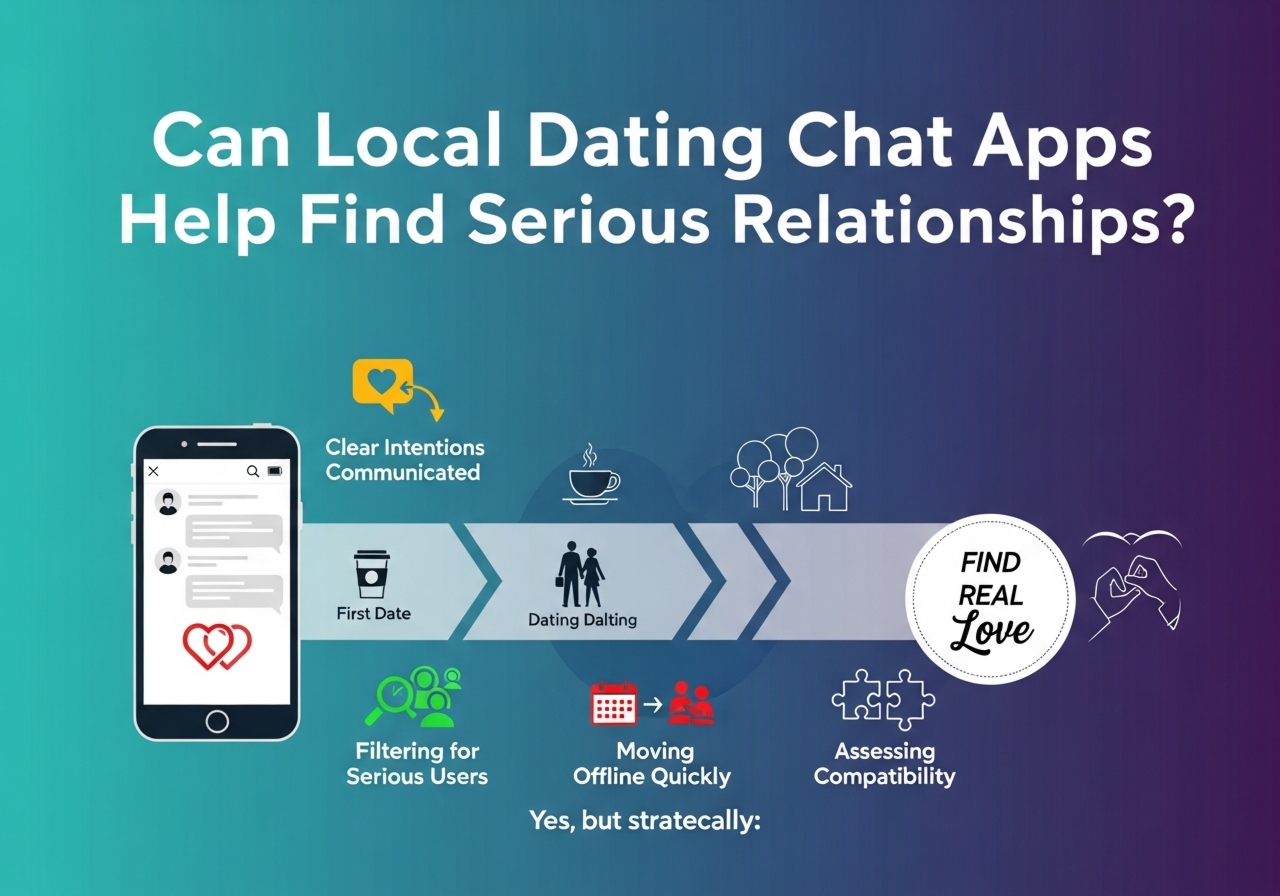
Can a local chat app really help you meet someone who wants the same long-term commitment you do?

Can Local Dating Chat Apps Help Find Serious Relationships?
Local dating chat apps have become a common way to meet people nearby. You might be wondering whether these tools are just for casual hookups, or if they can actually help you build a serious, lasting relationship. This article breaks down how local apps work, what features encourage commitment, how to use them effectively, and what pitfalls to watch for so you can make an informed choice.
What are local dating chat apps?
Local dating chat apps focus on connecting people who live near one another or share a common neighborhood, city, or region. They use location data, community features, and sometimes localized events to encourage nearby interactions rather than long-distance matches.
These apps vary in design: some prioritize real-time messaging and speed, while others build in compatibility questions, community groups, or interest-based filters. Understanding the differences helps you choose the kind of local tool that fits your goals.
How a local focus changes dating dynamics
When matches are nearby, you have more opportunities for face-to-face interactions and shared daily life. That proximity can speed up the transition from chatting to meeting, which may reveal compatibility in practical, real-world ways sooner.
At the same time, local contexts introduce social dynamics like mutual friends, shared hangouts, and community reputation. You’ll want to consider how those factors affect privacy, expectations, and the way relationships form.
Why local apps can help you find serious relationships
Local apps can support serious dating by increasing frequency of contact, making dates more convenient, and revealing lifestyle compatibility. When you can realistically integrate someone into your daily routines, it’s easier to assess long-term potential.
You also benefit from seeing how someone behaves in familiar, local settings—how they treat servers at local restaurants, whether they like similar neighborhood activities, and how they manage local obligations. Those small moments often matter in long-term compatibility.
Limitations of local dating chat apps
Local apps aren’t a guaranteed path to commitment. Proximity alone doesn’t equal emotional compatibility, and some local apps still reward quick matches or superficial choices. If an app’s culture emphasizes quantity over quality, you might find yourself swiping through many short-term interactions.
You also face practical limits: smaller local user pools can make finding someone compatible harder, and local reputation concerns may discourage risk-taking or vulnerability. It helps to combine app use with intentional, offline efforts.
Key features that support serious relationships
Certain app features are more likely to attract people seeking commitment. Look for features that go beyond photos and swipes and instead encourage depth, accountability, and reality-based compatibility.
- Detailed profiles and prompts to reveal values and long-term goals make it easier to screen for commitment.
- Personality or compatibility quizzes help you and potential matches discover alignment in priorities like family, career, or lifestyle.
- Verification tools increase trust and reduce catfishing, which matters when you plan to invest time and emotions.
- Event listings and group activities encourage natural, low-pressure ways to meet in a social setting rather than forcing one-on-one intensity too early.
Features to prioritize (summary table)
| Feature | Why it helps with serious relationships | What to look for |
|---|---|---|
| Profile prompts & essays | Encourages thoughtful sharing about values and goals | Open-ended prompts, sections for dealbreakers |
| Compatibility matching | Matches based on priorities, not just photos | Personality tests, long-term goal filters |
| Identity verification | Builds trust and reduces fraud | Photo verification, ID checks |
| Local events/groups | Creates shared experiences and social proof | Meetups, interest-based groups, community events |
| Messaging depth tools | Promotes meaningful conversations | Voice notes, long-form messages, guided questions |
| Privacy controls | Lets you manage visibility and local reputation | Block lists, selective visibility, neighborhood filters |
Choosing the right local app for a serious relationship
Not all local apps are created equal. You’ll want to pick a platform aligned with your values and relationship goals rather than one optimized for quick attention or casual meetups.
Consider the app’s user base (age range, relationship goals), its culture (casual vs relationship-minded), safety measures, and whether it supports meaningful discovery (long-form profiles, prompts, or compatibility tools). Trial multiple apps briefly, but focus on one or two that consistently produce higher-quality conversations.
How to set up your profile to attract commitment-minded people
Your profile should clearly communicate that you’re looking for something serious without sounding rigid or like you’re writing a dating résumé. Balance authenticity, warmth, and clarity.
- Start with a friendly opening line that reveals what you value—family, stability, shared hobbies—so like-minded people can recognize those priorities quickly.
- Use photos that show different sides of your life: a clear headshot, a picture doing a hobby, one with friends or family (if appropriate), and one in a local setting. These images signal your lifestyle and community ties.
- Fill prompts with specific examples rather than vague statements. Instead of “I love travel,” say “I take a long weekend trip to nearby parks every few months.” Specifics give people something to comment on and gauge compatibility.
- Be honest about what you want and what you won’t compromise on. People seeking relationships appreciate clarity and respect boundaries.
Conversation strategies that lead to deeper connections
Moving beyond small talk is essential if you want to find a serious relationship. The quality of your early conversations predicts whether you’ll get to meaningful dates.
- Use open-ended questions that ask about values and routines rather than only hobbies. For example, ask what someone’s ideal weekend looks like or what they hope a relationship brings into their life.
- Share stories about formative moments to invite vulnerability and reciprocity. You can prompt deeper replies by modeling them first.
- Set a rhythm for messaging that feels intentional: consistent, but not overwhelming. That helps build trust and signals availability without coming off as needy.
- Use voice notes or short video messages when appropriate. Hearing tone and seeing facial expressions reduces miscommunication and often deepens rapport more quickly than text alone.
Transitioning from chat to real-life dates
If you want serious relationships, you’ll need to move from app chat to face-to-face meetings in a way that builds connection without rushing or freezing. Local apps make that transition easier because proximity reduces logistics.
- Suggest low-pressure, local dates that allow for conversation and observation—coffee, a neighborhood walk, or a casual brunch. Those settings let you evaluate compatibility without high expectations.
- Plan the first meeting within a reasonable timeframe: a week to two weeks is often ideal. Waiting too long can let idealized images form, and meeting too soon can feel rushed.
- Communicate expectations about the first date: casual and exploratory is usually safest. If you’re looking to assess long-term potential, frame the date with that in mind by suggesting a place where you can talk.
- After the first date, debrief briefly with a message that includes both what you enjoyed and whether you want to see the person again. Honest, timely feedback moves things forward and demonstrates maturity.
Typical timeline for moving from chat to relationship (example table)
| Stage | Typical time window | Your goal |
|---|---|---|
| Initial match & messages | 0–7 days | Assess shared values and chemistry |
| Move to phone/voice | 3–10 days | Confirm tone and basic compatibility |
| First in-person meeting | 1–2 weeks | Evaluate ease of conversation and real-life fit |
| Casual repeated dates | 2–8 weeks | Experience each other’s routines and social circles |
| Exclusivity conversation | 6–12 weeks | Decide whether to commit and define relationship |
| Long-term planning | 3+ months | Build shared goals and integrate lives |
Safety and privacy considerations
Dating locally has benefits, but it also carries risks like unintended encounters or privacy leaks. Protecting yourself is essential when meeting neighbors or people in your community.
- Use app safety features: location blur, selective profile visibility, and verification tools help protect you from unwanted attention.
- Share meeting details with a friend, and consider setting a check-in time after your first few dates. Let someone know where you’ll be and who you’re meeting.
- Keep personal identifiers private during early chats—avoid sharing your full address, workplace details, or routine schedules until trust is established.
- Trust your instincts. If something feels off during a conversation or date, you don’t owe anyone continued interaction. You can end a chat or leave a date if your safety feels compromised.
How to read signals that someone wants a serious relationship
Not everyone will say they want the same things upfront. Watch for patterns that indicate relationship intent rather than occasional signals.
- Consistent communication is a strong sign. If someone regularly checks in, follows up after plans, and makes time for you, they’re likely investing emotionally.
- They introduce you to their local social circle or talk about integrating routines (running errands together, meeting friends). That indicates they envision you in their life.
- Conversations shift from hypothetical to concrete—planning weekend activities, talking about shared obligations, or discussing future goals.
- They ask about your boundaries, family plans, and values respectfully rather than prying or pressuring you.

Red flags that suggest the person isn’t looking for commitment
Local proximity can blur boundaries quickly, so watch for behaviors that indicate the person isn’t seeking a long-term relationship.
- Mixed signals: they might be affectionate in private chats but evasive about meeting or serious topics.
- Pushes for secrecy or insistence on meeting in private spaces right away. That can be a sign of avoidance or lack of respect for your safety.
- Unwillingness to define the relationship after repeated involvement. If you regularly see each other but the person refuses to discuss exclusivity or plans, they may not be ready to commit.
- Repeated cancelations or inconsistent availability that suggest you’re a convenience option rather than a priority.
Handling rejection and ghosting gracefully
Rejection and ghosting are common in online dating, and local apps don’t eliminate that pain. How you respond affects your emotional health and future dating success.
- Allow yourself to feel disappointment, but don’t personalize it as a statement of your worth. People have many reasons for their behavior that often have little to do with you.
- If someone ghosts you, avoid chasing. A brief follow-up message is fair, but repeated attempts rarely change outcomes and can harm your self-respect.
- Practice reframing the experience as data: each interaction teaches you about preferences and signals that help refine your search.
- Keep a support system—talk to friends or a therapist if rejections become overwhelming, as regular emotional support helps you maintain perspective.
Combining local apps with offline strategies
Relying only on apps can produce tunnel vision. Combining online matches with local, offline activities increases your chances of finding someone serious.
- Attend local classes, volunteering events, or community meetups where you can naturally meet people who share interests and values.
- Use app events and groups as a bridge to real-world social circles rather than the sole method of meeting people.
- Encourage friends to introduce you to other local singles. Referrals often come with context and social proof, which helps in building trust.
- Continue building a meaningful life offline: hobbies, friendships, and routines that make you more attractive and fulfilled, which naturally draws relationship-minded people.
How to use app features to filter for commitment
Many apps include filters and tools to narrow matches by relationship intent. Use those deliberately so you don’t waste time on incompatible people.
- Set profile filters to show people who indicate “looking for a long-term relationship,” “marriage,” or similar options when available.
- Use compatibility questions and long-form prompts to identify shared priorities before heavy investment.
- Consider premium features that help highlight serious users—some apps offer filters for those who verified their intentions or completed compatibility quizzes.
- Be proactive in asking about relationship expectations early in a natural, respectful way. If your goals don’t match, it’s kinder to both of you to clarify sooner.
Common mistakes that sabotage finding commitment
Even when you use local apps, certain behaviors can unintentionally block deeper connections. Avoid these predictable pitfalls to increase your odds.
- Moving too fast emotionally or physically before establishing trust can create confusion and uncertainty.
- Communicating inconsistently or being passive about plans often signals low investment.
- Presenting an inauthentic self (over-curated photos, vague goals) leads to mismatches once you meet in person.
- Ignoring red flags because of convenience or proximity will lead to stress later. It’s okay to prioritize long-term compatibility over short-term comfort.
Case studies: realistic scenarios
Reading examples helps you see how strategies play out. The following hypothetical scenarios show different outcomes based on approach and intent.
- Scenario 1: You join a neighborhood-focused app with compatibility prompts and meet someone who shares weekend routines. You quickly move from coffee dates to mutual friend dinners, then decide on exclusivity within two months—because you tested daily-life compatibility early.
- Scenario 2: You use a fast-match local app and rely only on photos. You go on multiple casual dates but find emotional depth lacking. You pivot to a local niche app with longer prompts and start having more meaningful conversations.
- Scenario 3: You connect with someone who seems serious but avoids public meetings and refuses to introduce you to friends. You stop investing and later discover they weren’t ready for a relationship, saving you months of emotional confusion.
Each scenario shows how clarity, the right platform features, and attention to behavior shape outcomes.
Measuring success and managing expectations
Finding a serious relationship often requires time, resilience, and experimentation. You’ll want to set realistic goals and measures of progress rather than only tally matches.
- Track quality metrics: number of meaningful conversations, number of in-person meetings, and how many connections lead to repeat dates. Those numbers tell you more than raw match counts.
- Set process goals (e.g., initiate two meaningful conversations per week, go on one local date every two weeks) instead of outcome-only goals (e.g., “find a partner by next month”).
- Be prepared for cycles: sometimes you meet people quickly, and sometimes the best matches take months to find. Patience combined with intentional action wins out.
- Celebrate small wins like honest conversations, respectful rejections, and clarity about your wants and needs—these are progress markers.
Frequently asked questions
Can local apps really increase your chances of finding a long-term partner?
Yes, local apps can increase your chances by making in-person meetings easier and revealing day-to-day compatibility sooner. However, app features and your approach determine whether you’ll meet commitment-minded people or casual daters.
How long should you get to know someone online before meeting?
A week or two of consistent messaging is a practical window for local matches. That timeline lets you gauge communication style and values while preventing unrealistic idealization.
Is it safer to meet someone from a local app than from a large dating platform?
Safety depends on the app’s verification tools and your behavior. Local apps can reduce travel-related safety concerns, but you should still follow standard safety practices like meeting in public places and telling a friend about the date.
Should you disclose your intentions in your profile?
Yes, clarity in your profile helps filter out incompatible matches and attracts people who want the same things you do. Be straightforward but open-minded—phrasing your intent in a friendly way increases response rates.
How do you handle mutual acquaintances in a small community?
Mutual acquaintances are common in local settings. Decide in advance how public you want the relationship to be, and be honest if you’re concerned about privacy. Letting mutual friends know your comfort level helps prevent awkward situations.
Practical checklist to maximize success on local dating chat apps
- Choose one or two apps that prioritize relationship features.
- Complete verification and detailed profile sections.
- Use local photos and community cues to signal lifestyle fit.
- Start with open-ended, value-focused conversation prompts.
- Move to phone or voice chats within the first week.
- Schedule a low-pressure local date within 1–2 weeks.
- Evaluate behavior across multiple interactions before deciding on exclusivity.
- Protect your privacy and use safety features.
- Combine app use with offline community engagement.
Final thoughts
You can use local dating chat apps effectively to find serious relationships if you choose platforms that encourage depth, present yourself authentically, and transition thoughtfully from chat to in-person connection. Proximity is an advantage when combined with clarity, intentionality, and consistent standards for what you want.
Remember that technology is a tool—not a guarantee. Your actions, boundaries, and the way you read signals and responses matter most. If you stay intentional, patient, and true to your values, local apps can be a powerful part of your path to a meaningful, long-term partnership.